


Buying Google Reviews? Why It's Risky
Why buying Google reviews breaches the UWG and Google's guidelines, how to spot fakes, and which trio of collecting, replying and reporting works genuinely and lastingly.
Practical guides, strategies and current news about Google reviews and review management.
You report a Google review by opening the business in Google Maps or Google Search, clicking the three dots next to the review and selecting "Report review". Google typically reviews the report within 3–14 days against 9 official content policies. The decision on removal is made solely by Google. Self-service tools like Sternehero automate the submission – 1 credit = 1 report.
The topic hubs take you straight to the right guides — from your first report to multi-location governance.
You start with a first assessment, then understand the complete reporting process, and finally learn the 9 official violation grounds.
Don't reply immediately. First categorise: legitimate, borderline or reportable? A 4-step plan, 5 reply templates and a clear escalation threshold to a lawyer.
The processA 5-step guide: all 9 official violation reasons, escalation via the Google Transparency Center and when a self-service tool noticeably reduces the workload.
The fundamentals9 official violation reasons with concrete violation / non-violation examples, 3 checks before every report, a manual-vs-self-service comparison and 2 practical use cases.
Why buying Google reviews breaches the UWG and Google's guidelines, how to spot fakes, and which trio of collecting, replying and reporting works genuinely and lastingly.
How AI turns a star value and text into a draft reply, where the line between replying and reporting runs, and why manual approval keeps the reply authentic.
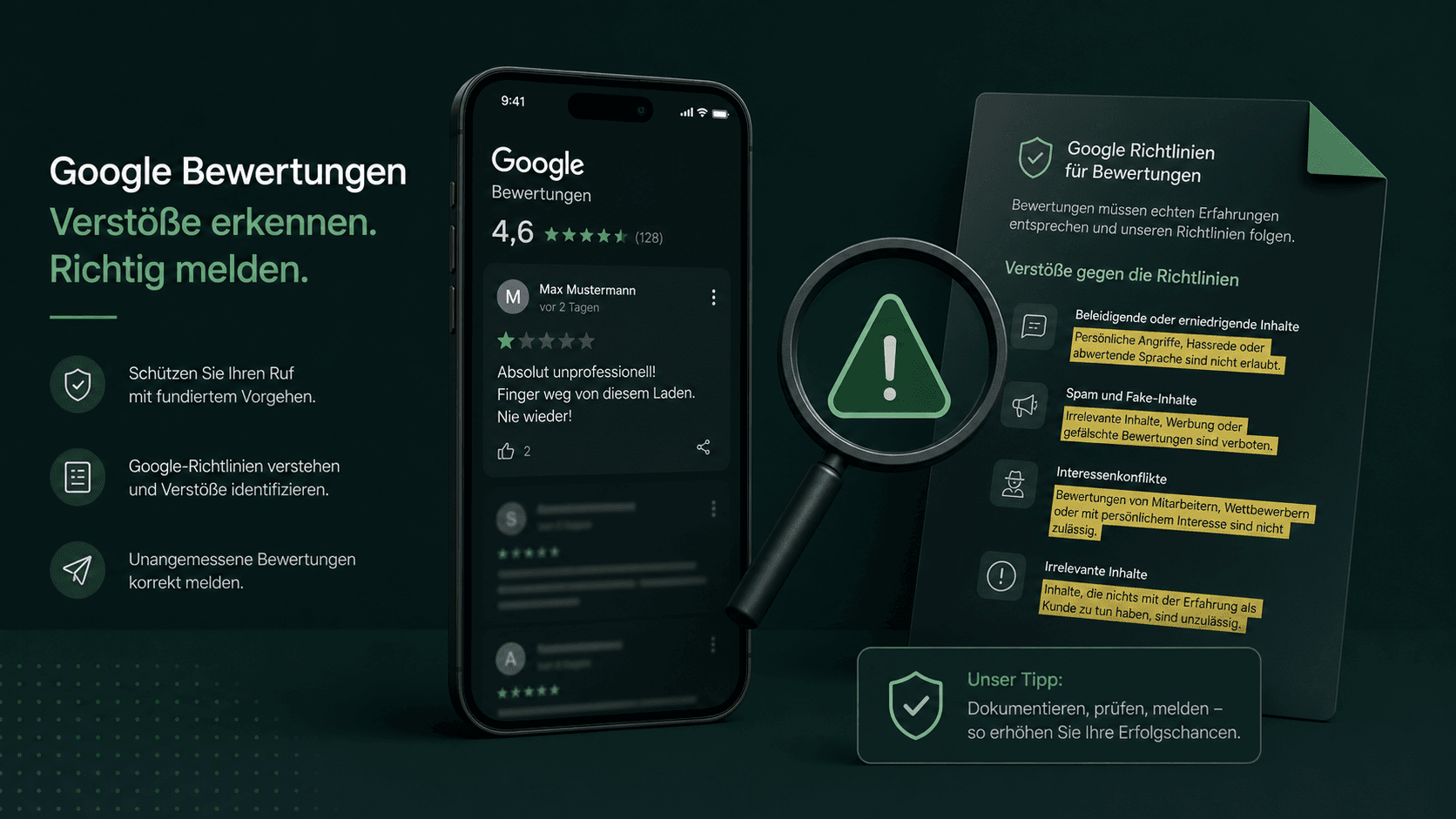
What's allowed in Google reviews (including harsh criticism), which six violation grounds make a review reportable, and the reporting route step by step.
Ready-made text blocks for every violation ground, the 3-block structure of a factual report justification, and why a template structures the case – while the decision stays with Google.
9 in 10 consumers read reviews, 5–9% revenue per star, 4.0 as the critical threshold, 170+ million fake reviews removed per year – all key figures with sources.
You start with 3 free credits and test the complete reporting process yourself. The platform decides.
Get started freeCredits never expire · No subscription requiredThere is no expiry for Google reviews. When old reviews are still reportable, what applies after a business takeover, and how an old star average recovers mathematically.
Reportable violations, kununu's verification procedure with deactivation during the check, the anonymity lever when no employment relationship exists – and realistic expectations.
Flagging instead of deleting: reportable violations, the verification request when customer contact is missing, and the abuse trap of indiscriminate flagging.
Request a feedback revision, report to eBay or check automatic removal: the three routes against unfair eBay feedback – including handling feedback extortion.
Insults, mix-ups and courier delays: what's reportable on Lieferando, how the partner service route works, and why the courier handover time is your most important evidence.
The 4-sentence formula (thank, take seriously, contextualise, offer a solution), templates for four typical situations, the 5 costliest mistakes – and the line where you report instead of replying.
The 3-sentence formula (thank, repeat a detail, invite back), 6 examples from the 5-star review to the regular customer – and why the repeated detail strengthens your profile.
Check, reply, report if applicable: the 3-step plan for comment-free 1-star ratings, 3 templates depending on customer matching and the realistic reporting grounds.
Where does permissible criticism end and reportable defamatory criticism begin? The value-judgement/factual-claim distinction, a comparison table and the step-by-step reporting route.
A pure 1-star review without text usually stays online. When a star rating does violate Google's guidelines after all – with comparison table and a 6-step plan.
14 selection criteria as a decision matrix, 4 tool categories (US suites, GBP tools, DACH specialists, all-in-one), pricing models and 5 typical mistakes in tool selection.
70% less response time with AI Reply, a 3-step workflow with human-in-the-loop, 5 response types that must never be auto-published, GDPR + DPA.
Audit hook with 22–34% conversion, 3-touch LinkedIn funnel, cold email template and a Hamburg-Eppendorf use case: 3 new clients in 90 days.
5 service packages (audit, reply, reporting, acquisition, crisis hotline), a margin table with ~89% gross margin, tool stack and a Stuttgart use case of +18% recurring revenue.
12 mandatory requirements for a white-label reputation tool, margin comparison of monthly licence vs. credits, 4 onboarding pitfalls and a Frankfurt use case.
Tablet workflow for 25–40% conversion, GDPR on home visits, what's reportable in the trades (and what isn't), local pack velocity and ROI for 5-person businesses.
7 acquisition channels with conversion ranges, UWG and GDPR boundaries, 3 forbidden anti-patterns, a ready-to-use email template and a Bremen use case.
Conflict of interest is a clear violation. 4 detection heuristics, reporting workflow, employment-law thresholds and Kununu-vs-Google delineation.
Don't reply immediately. First categorise: legitimate, borderline or reportable? A 4-step plan, 5 reply templates and a clear escalation threshold to a lawyer.
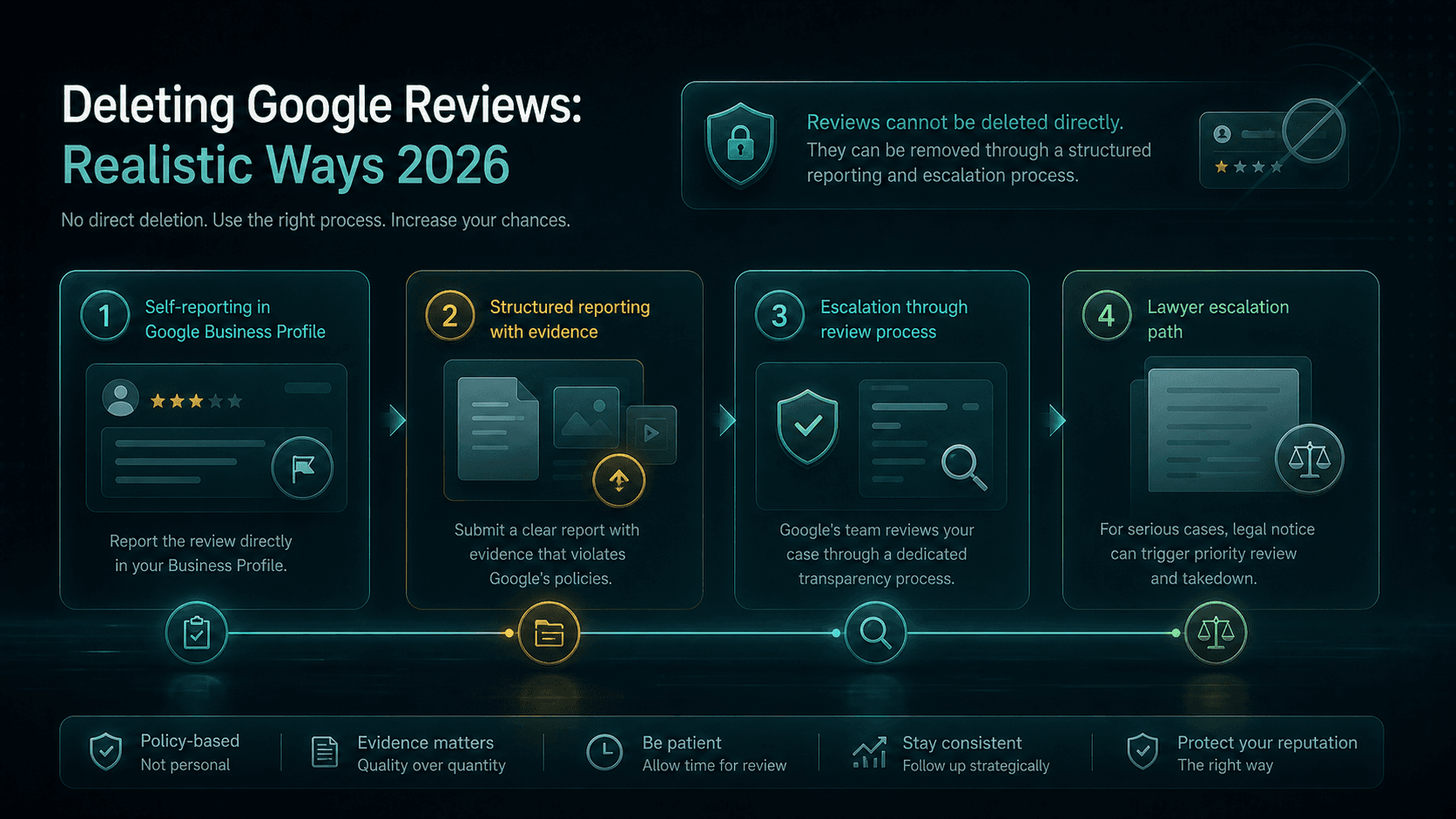
Nobody removes a Google review directly – only Google itself does. 4 realistic escalation paths from self-service to lawyer, costs €0–3,500.
A 5-step guide: all 9 official violation reasons, escalation via the Google Transparency Center and when a self-service tool noticeably reduces the workload.
A 1-star review can cost SMBs €5,000–€10,000 per year. Harvard study, two worked examples and a 3-step strategy to counter it.
Recurring service with 60–70% margin: white-label setup, three package models, four acquisition channels and two real use cases for agencies in the DACH region.
From a starter package (€399) to multi-location (€2,499): four cost components, three ready-to-use package calculations, industry multipliers and upsell paths.
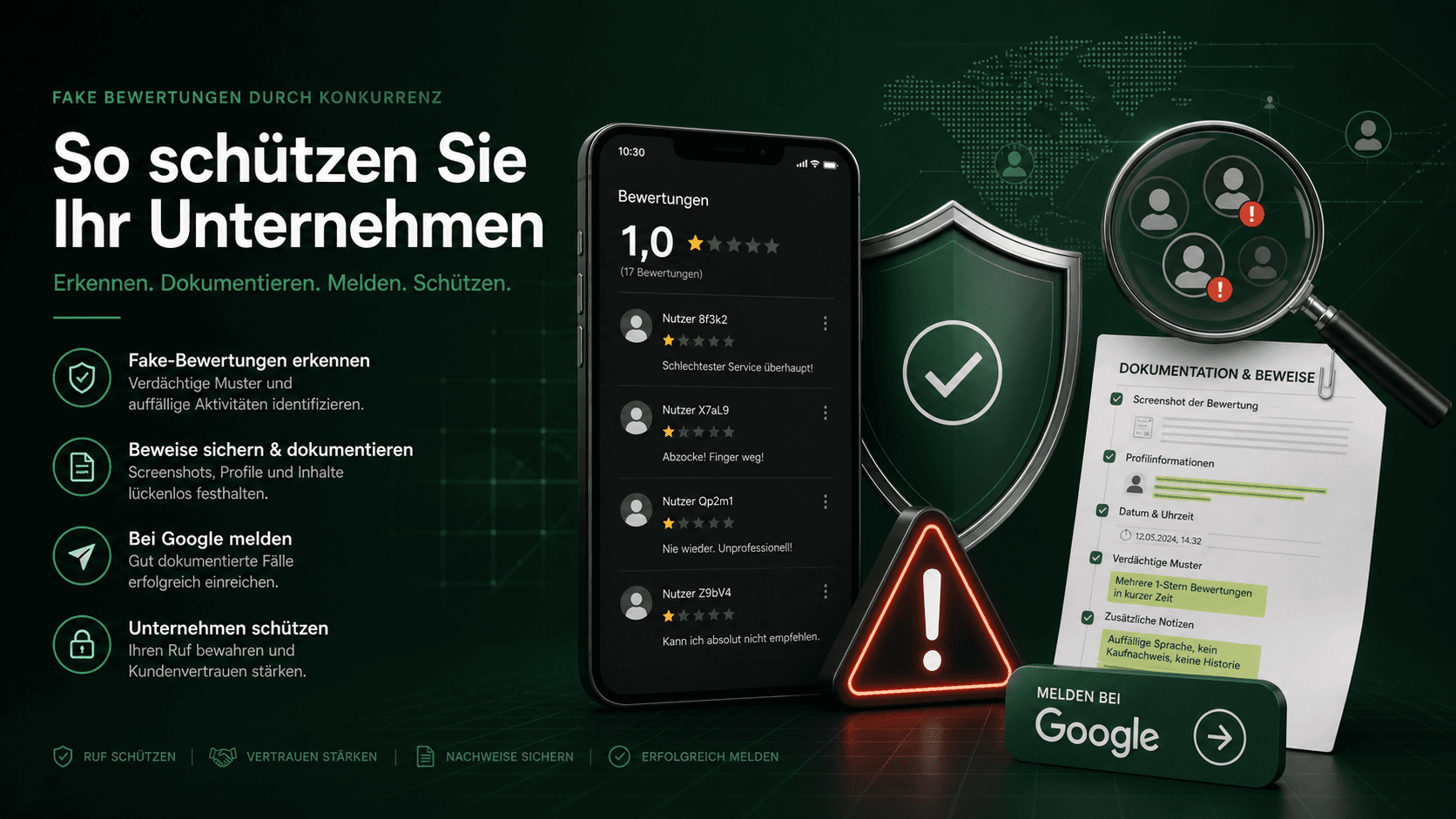
5 classic and 2 new fake patterns (AI reviews, coordinated mini-waves) – plus a 60-second operator workflow and concrete next steps.
14 operational levers for GBP / Google My Business: profile fundamentals, content, review signals and Schema.org anchoring – including 5 GBP killers and the multi-location reality.
4-rule method plus 3 reply-type examples, 5 anti-patterns, GDPR pitfalls for regulated healthcare professions and an AI Reply workflow for sole proprietors and agencies.
9 official violation reasons with concrete violation / non-violation examples, 3 checks before every report, a manual-vs-self-service comparison and 2 practical use cases.
The 3 ranking pillars, 4 review levers (quantity / quality / recency / response rate), 3 often overlooked factors and review hygiene as an SEO measure.
4 attack patterns, 6-step protection plan, clear escalation threshold platform vs. lawyer – and two practical use cases (trades in Bremen / opticians chain with 8 locations).
§ 203 StGB, GDPR Art. 9, code of conduct: permitted vs. forbidden reply phrasing, mandatory DPA workflow and 2 use cases (dermatology practice / practice-marketing agency).
Triage list reportable vs. not reportable, 5 reply recipes with templates, acquisition conversion table, December effect and 2 use cases (Berlin trattoria / burger franchise with 14 locations).
Recognise 4 wave types, a 72-hour playbook in four phases, 5 typical crisis-response mistakes and a clear escalation threshold platform vs. lawyer.
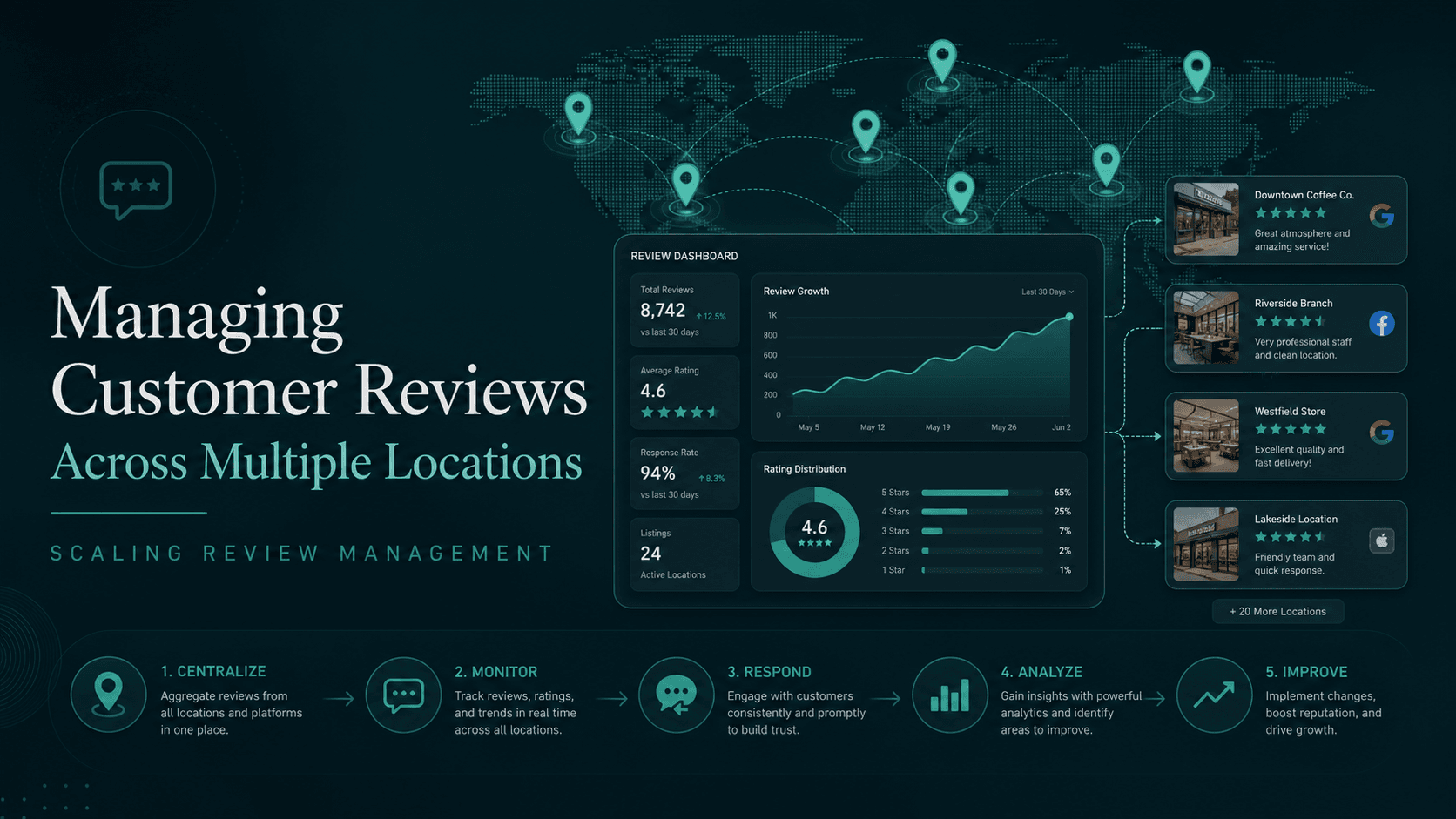
5, 50 or 500 branches: location hierarchy, reply templates, centralised reports and reporting at branch and regional level.
7 KPIs, tiering by audience (C-level / marketing / branch management), a story frame (baseline → activities → outcome → recommendation) and two case studies.
White-label reseller instead of in-house build: 50–70% revenue share, 4–6 weeks time-to-market, 3 pricing models and a 90-day go-to-market – plus GDPR clarity and a Zurich use case.
Three brand archetypes (industry, geography, service), 4 brand decisions in 30 days, tech stack under €2,500, a three-tier pricing model and a 90-day launch plan – plus GDPR clarity.
5 local pack ranking pillars, 4 multi-location anti-patterns, a 3-tier framework (HQ → regional → location), 5 KPIs and a hair-salon-chain use case: +32 percentage points local pack share in 9 months.
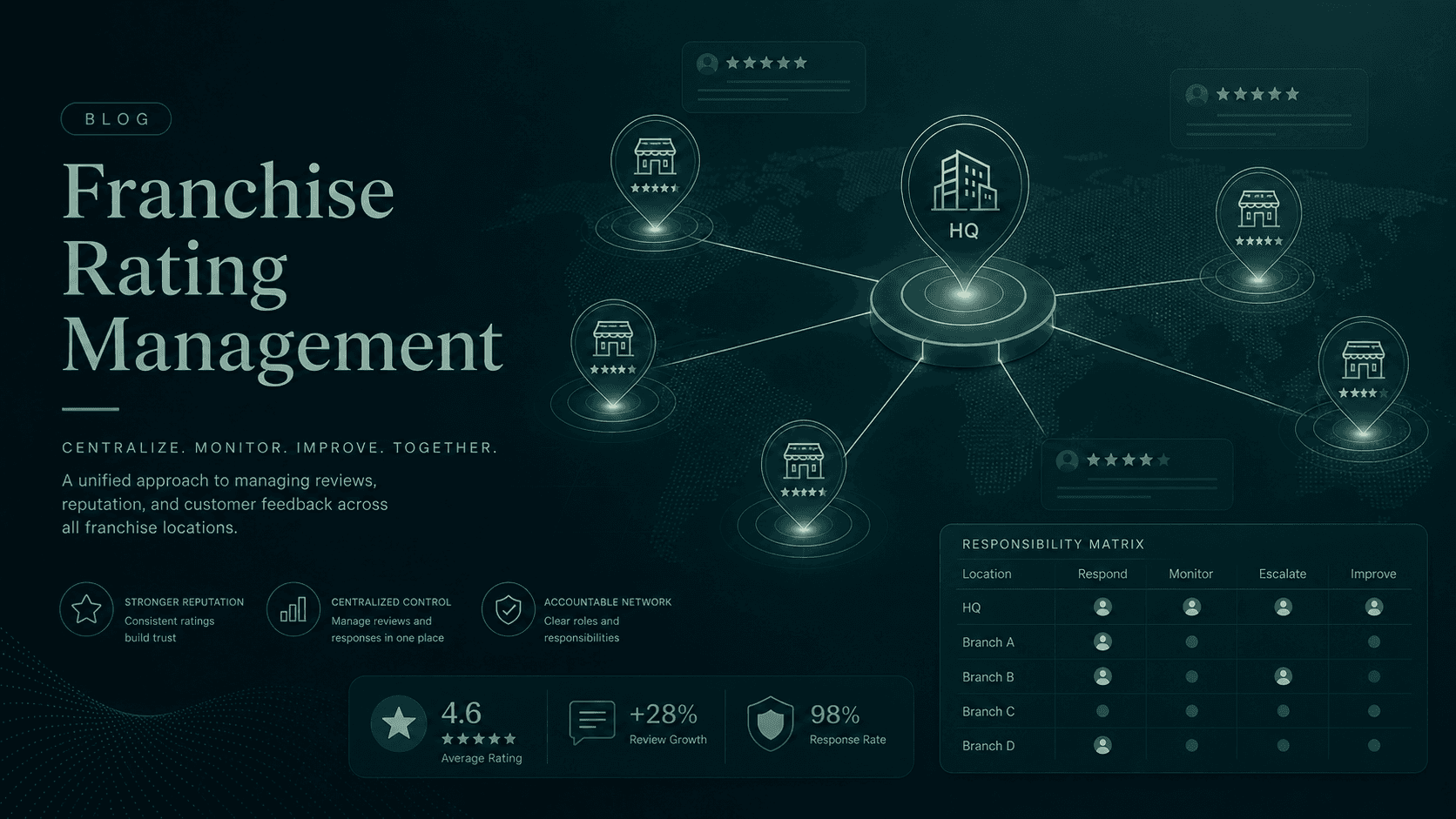
6 mandatory standards (reply, tone, acquisition, reporting, crisis, reporting), 4 contract clauses verbatim, a 7-row responsibility matrix and a fitness-franchise use case: response rate from 67% to 94% in 90 days.
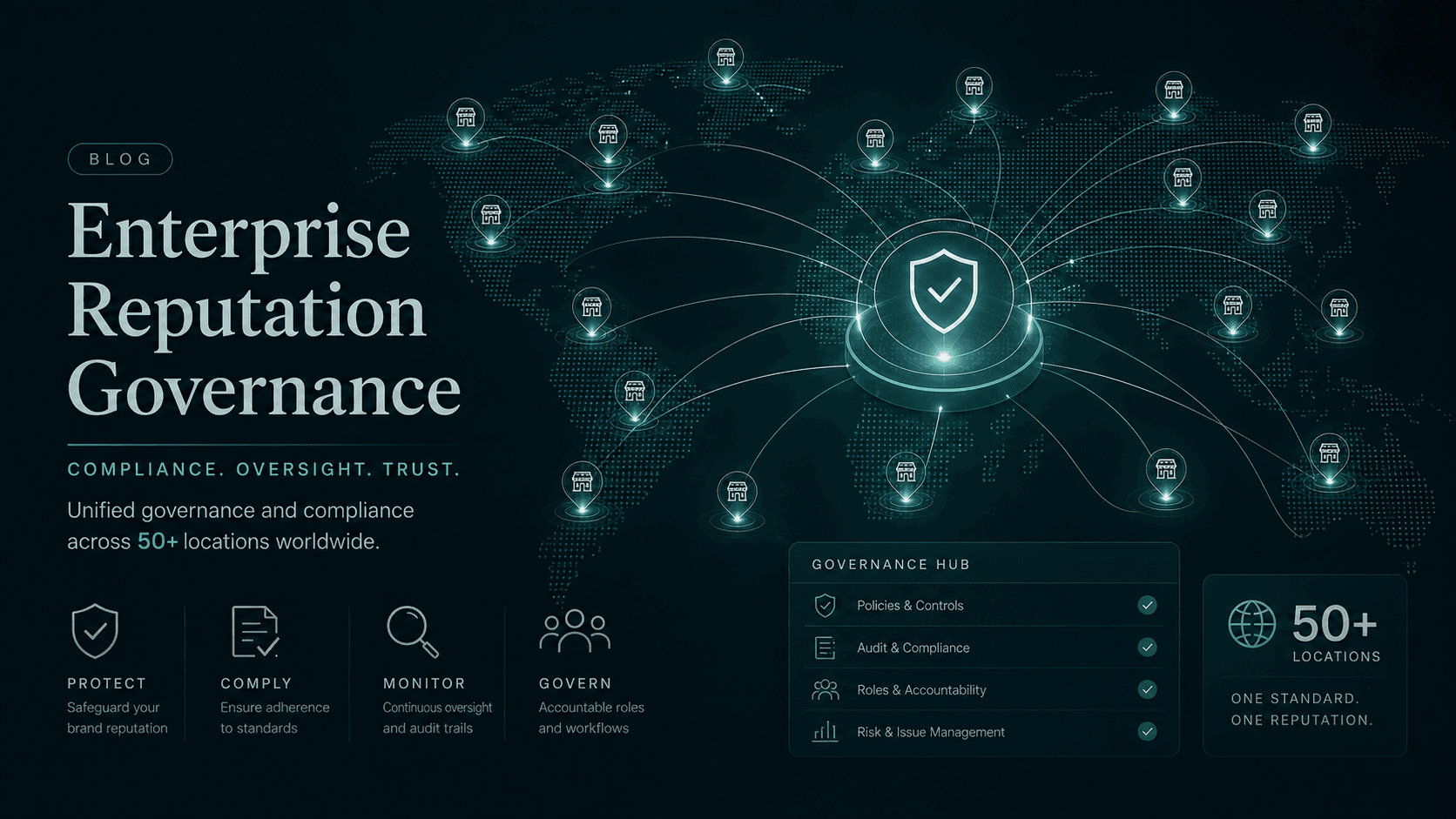
5-pillar governance framework (data protection, workflow, audit trail, roles, crisis), 14-point audit checklist, 4-class risk model and a pharmacy-group use case: 117 locations, group audit passed, zero findings.
Practical guides, platform updates and review management tips – every 2 weeks, no spam.